
潘惠杰 特聘研究员
Prof. Huijie Pan
办公室:仙林校区化学楼G223
邮 箱:huijie.pan@nju.edu.cn
2021-present Associate Professor Nanjing University
2017-2021 Post-doctoral Research Fellow, École Polytechnique Fédérale de Lausanne, Switzerland
2016-2017 Research Assistant, National University of Singapore, Singapore
2012-2016 PhD Student, National University of Singapore, Singapore
潘惠杰 副教授、博士生导师。2012年本科毕业于浙江大学高分子科学与工程学系;2016年博士毕业于新加坡国立大学(NUS)化学系(导师:赵宇教授);2017年至2021年在瑞士洛桑联邦理工学院(EPFL)从事博士后研究工作(合作导师:胡喜乐教授)。2021年5月入职南京大学化学学院,同时加入南京大学化学和生物医药创新研究院(ChemBIC)以及配位化学全国重点实验室。获欧盟玛丽居里学者奖学金(2018),入选国家高层次人才青年项目(2021),担任国家重点研发计划首席青年科学家(2022)。主要研究方向为合成生物学,人工酶催化,仿生催化,绿色合成化学等。
Reprogramming the Functions of Natural Proteins via Cofactor Engineering
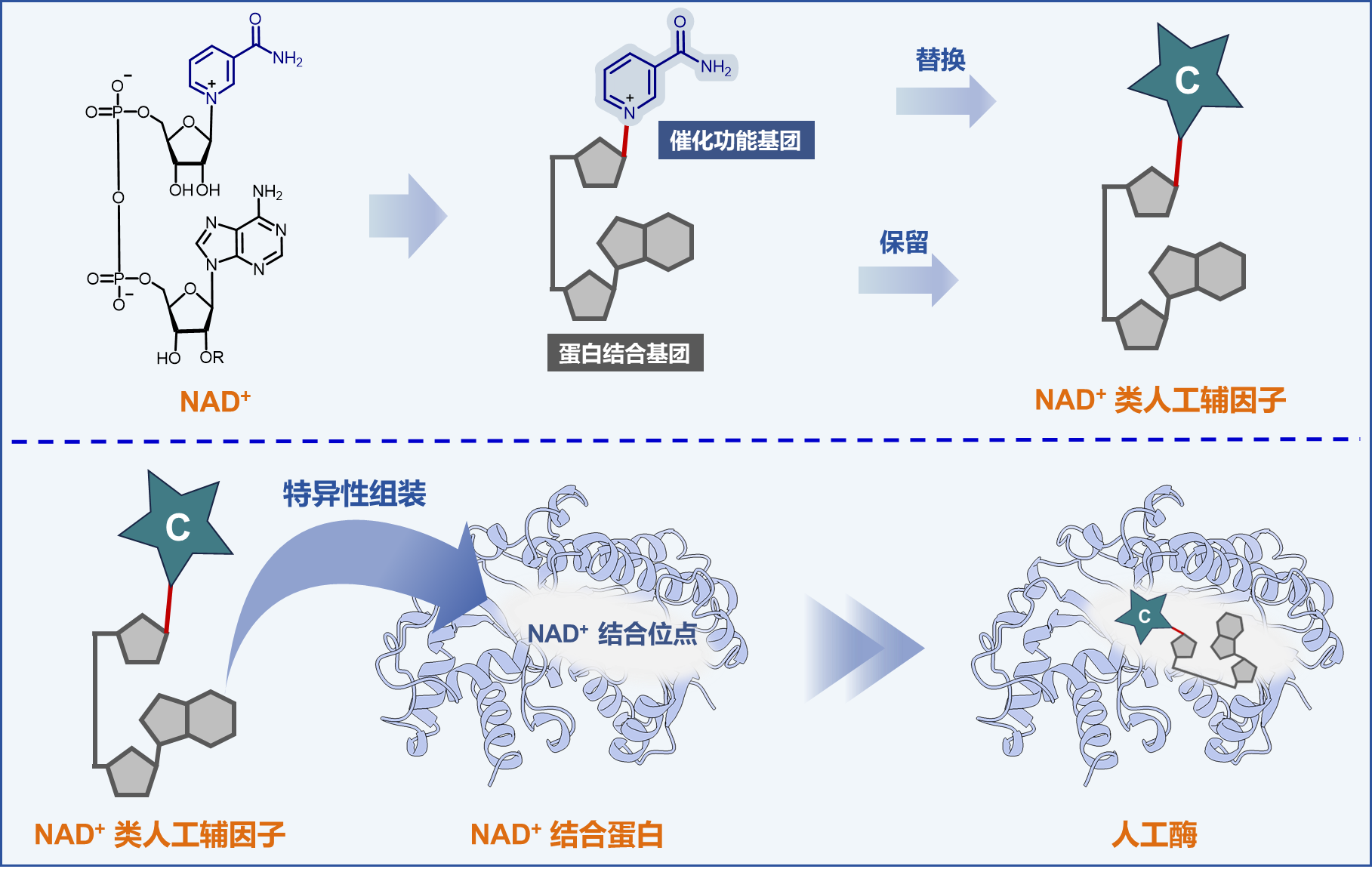
Natural enzymes achieve diverse catalytic functions not only through amino acid residues, but also through small-molecule cofactors that often dynamically and reversibly assemble with protein scaffolds. However, most current artificial enzyme strategies rely on covalent modification, unnatural amino acid incorporation, or high-affinity supramolecular anchoring to introduce non-natural catalytic units, which often limits the diversity of usable protein scaffolds and the generality of enzyme design. In this context, our research focuses on developing artificial universal cofactors to reprogram the functions of natural proteins. By preserving the recognition motifs of native cofactors, such as NAD+ and glutathione, while replacing their catalytic units with photoactive, organocatalytic, or metal-based functional groups, we aim to construct modular artificial enzyme platforms through reversible cofactor–protein assembly. This strategy enables rapid functional diversification of natural protein families and provides a general approach to expanding the catalytic boundary of enzymes.
Developing New Artificial Metalloenzymes Based on Established Platforms
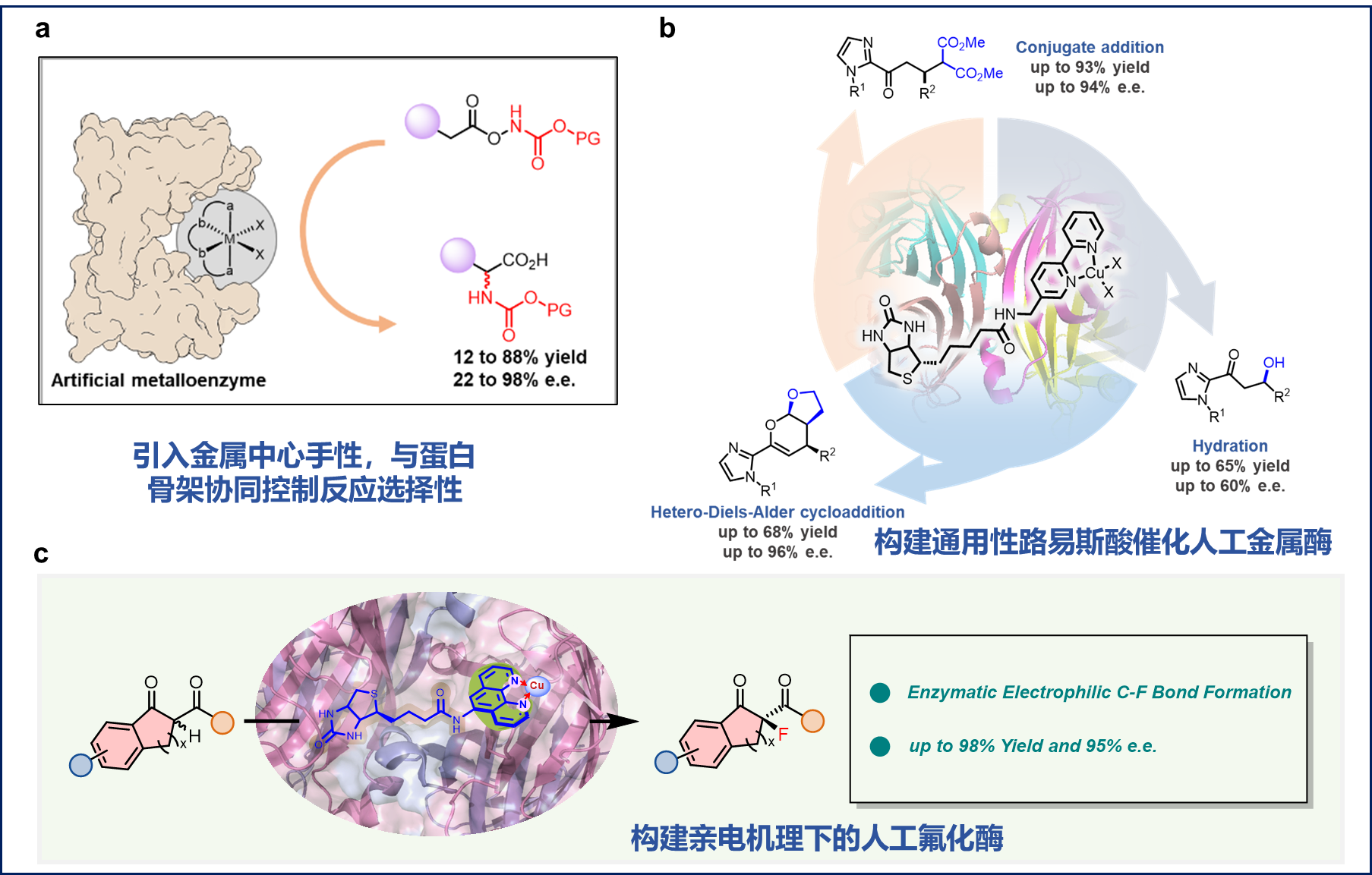
Artificial metalloenzymes combine the broad reactivity of transition-metal catalysts with the evolvable chiral environment of proteins, providing powerful systems for new-to-nature transformations. The biotin–streptavidin system is one of the most established platforms in this field, but its further development requires new cofactor structures, interaction modes, and catalytic mechanisms. Our research focuses on designing artificial metal cofactors with distinct coordination environments or functional units, and incorporating them into streptavidin to develop new artificial metalloenzymes with novel activity and selectivity.
Mechanistic Studies and Catalytic Applications of [Fe]-Hydrogenase
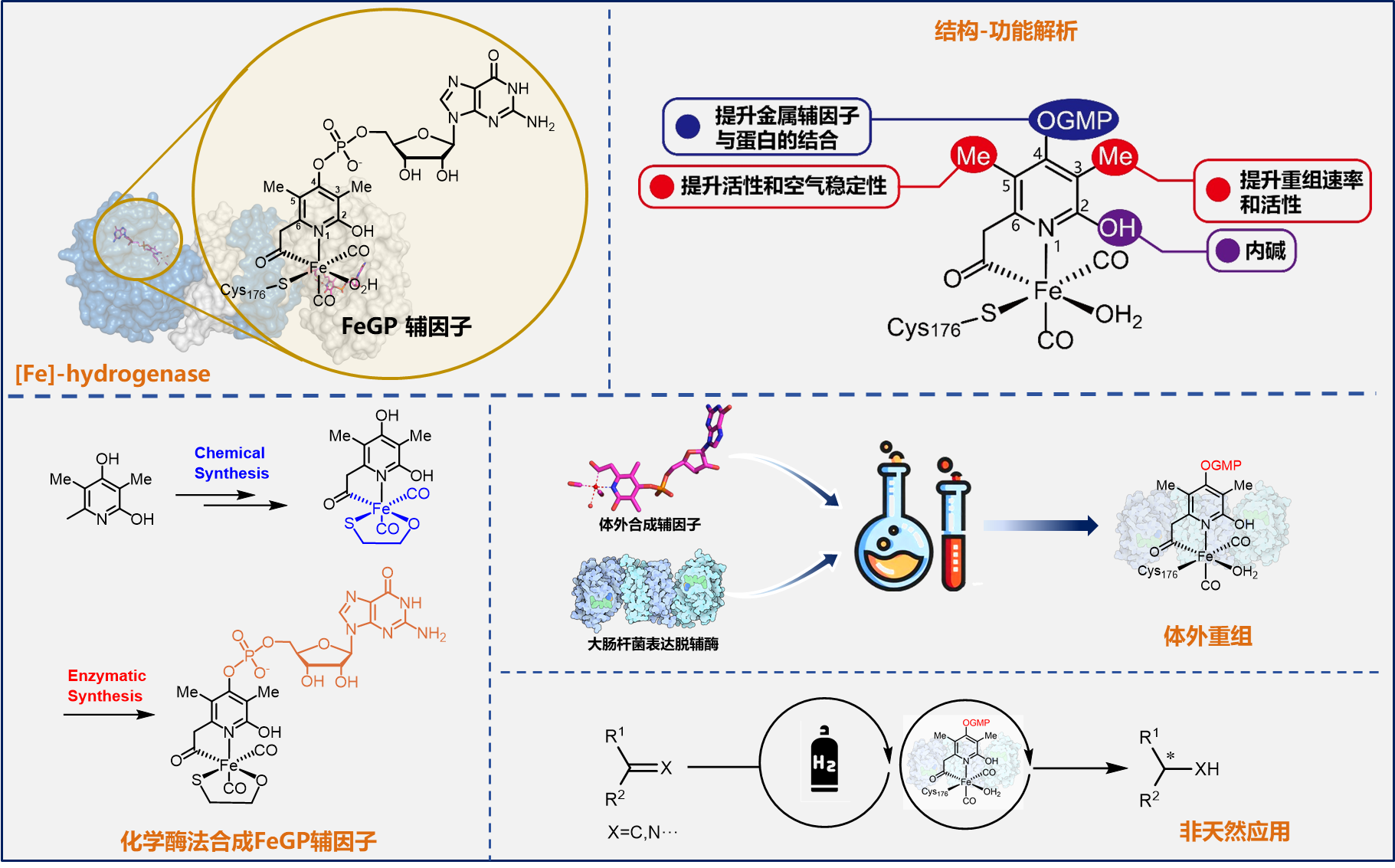
[Fe]-hydrogenase is a unique metalloenzyme that catalyzes reversible H2 activation under mild conditions using the unusual FeGP cofactor. However, its archaeal origin, difficult purification, complex cofactor biosynthesis, and poor evolvability have greatly limited mechanistic studies and practical applications. Our research focuses on the artificial reconstruction and functional exploration of [Fe]-hydrogenase. By combining biomimetic synthesis, chemoenzymatic cofactor construction, in vitro reconstitution, and protein engineering, we aim to clarify the structure–function relationship of the FeGP cofactor, overcome the accessibility problem of this enzyme system, and develop engineered [Fe]-hydrogenases for non-natural catalytic transformations.
1. An NAD⁺ analogue enables assembly of structurally diverse artificial photoenzymes for enantiodivergent [2 + 2] cycloadditions. Du, P.; Li, J.; Zhou, T.-P.; Wang, J.; Hu, W.; Li, H.; Wang, B.*; Pan, H.-J.*, Nat. Catal. 2025, 8, 822–832.
2. Reconstitution of [Fe]-Hydrogenase with Model Complexes Reveals Functional Roles of Methyl Groups in the Metallocofactor. Wang, C.; Li, H.; Li, J.; Wang, C.; Yu, J.; Shima, S.; Huang, G.*; Pan, H.-J.*, J. Am. Chem. Soc. 2025, 147, 23758–23765.
3. Enantioselective [2π+2σ] Cycloaddition to Bicyclo[2.1.1]hexanes Enabled by an Artificial Photoenzyme. Li, J.; Du, P.; Zhou, T.-P.; Hu, W.; Li, H.; Wang, B*.; Pan, H.-J.*, J. Am. Chem. Soc. 2026, 148, 13755–13763.
4. A Modular Cu(II)-Based Artificial Metalloenzyme for Enantioselective Lewis Acid Catalysis. Chen, Q.; Yu, J.; Wang, C.; Zhao, J.; Pan, H.-J.* ACS Catal. 2026, 16, 6318–6325.
5. Reprogramming NAD(P)+-Binding Proteins for Iminium Biocatalysis via a Synthetic NAD+-Type Cofactor. Wang, S.; Zhang, B.; Hu, W.; Wang, H.; Zhao, J.; Pan, H.-J.*, Angew. Chem. Int. Ed. 2026, 65, e2116720.
