王敏燕 副教授
Prof. Minyan Wang
办公室: 仙林化学楼D511
邮 箱: wanmy@nju.edu.cn
2019-present Associate Professor, Nanjing University
2016-2019 Associate Researcher, Nanjing University
2014-2016 Postdoctoral Research Fellow in TU Kaiserslautern, Germany
2009-2014 PhD in Organic Chemistry, Zhejiang University
2005-2009 B. S. in Applied Chemistry, Huazhong University of Science of Technology
王敏燕 副教授、博士生导师。2009年本科毕业于华中科技大学,2014年于浙江大学化学系获得博士学位(导师:麻生明 院士)。2014年至2016年在德国TU Kaiserslautern做博士后研究(合作导师:Prof. Lucas Gooßen)。2016年底加入南京大学任副研究员,2019年12月被聘为南京大学化学化工学院副教授。2024年获江苏省杰出青年基金,2025年入选国家万人计划青年拔尖人才。主要从事配位有机化学,计算有机化学等方面的研究。发展基于动态反应网络与主动学习算法的多模态计算框架,揭示复杂体系中多维选择性调控机制,实现从理论尺度到实验尺度的选择性设计。
Catalytic Reaction Mechanism
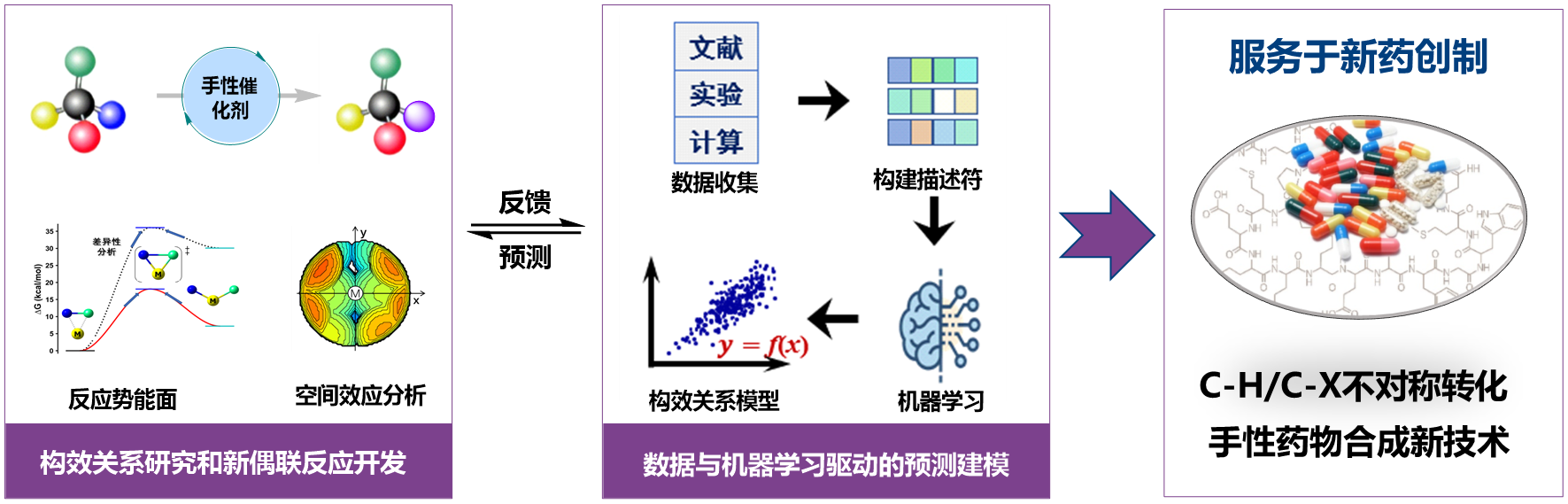
Metal-catalyzed organic reactions involve the rapid transformation of multiple reactive intermediates, which exhibit high activity and short lifetimes, making them difficult to capture and characterize using traditional experimental methods. Therefore, the study of the catalytic reaction mechanisms is challenging. By combining theoretical calculations and experiments, we explore the regulation of non-covalent interactions in the selectivity of metal catalysis, reveal the intrinsic laws of chemical, regional, and stereo-selectivity control, and propose possible reaction pathways.
Mechanism-Oriented Catalyst Design
Based on the non-covalent interaction-based selectivity control model, we simulate the effects of steric and electronic factors on the activity of metal catalysts. By designing multifunctional and multi-center metal catalysts, it enhances the nucleophilicity or electrophilicity of these catalysts, enabling the precise manipulation of stereo and chemical selectivity.
Machine Learning-Driven New Reaction Development
Based on a large amount of experimental data, we perform flux calculations to obtain descriptors that describe the electronic and spatial effects of different catalysts. Then, QSAR and QSPR methods were applied for analyzing and fitting the collected data. A linear regression model was constructed using theoretical calculation descriptors and catalytic performance, which allowed for designing and predicting new high-yield metal catalysts or catalytic systems.
1. Jie Zhu, Yue Zhao, Shengming Ma,* and Minyan Wang*, Regio-, Stereo-, and Enantioselective Copper-Catalyzed Allylation of Sulfinylamines with Allenes. Angew. Chem. Int. Ed. 2025, 64, e202515183.
2. Qinqin Wu, Shuo Yang, Minyan Wang,* Ping Lu*, Tunable Formal Photocycloaddition of 1‑Naphthol Derivatives. J. Am. Chem. Soc. 2025, 147, 28810−28819.
3. Qianwei Chen, Minyan Wang*, Yue Zhao, Zhuangzhi Shi*, Catalytic aromatic C−H borylation via strained Si and Ge metallacycles, Nat. Commun. 2025, 16, 8163.
4. Lin Lin, Tianbao Wu, Minyan Wang,* Ronghui Huang, Xiuxiu Yang, Yue Zhao, Zhuangzhi Shi*, Quaternary Phosphonium Salts Enable Palladium-Catalyzed Annulative C-H Activation of Aminophosphines with Alkynes. Angew. Chem. Int. Ed. 2025, 64, e202505454.
5. Linlin Ding, Yue Zhao, Hongjian Lu, Zhuangzhi Shi, and Minyan Wang*, Nickel-Catalyzed Asymmetric Propargyl-Aryl Cross-Electrophile Coupling. Angew. Chem. Int. Ed. 2024, 63, e202313655.
