
何卫江 教授
Prof. weijiang He
办公室:仙林化学楼C509
邮 箱:heweij69@nju.edu.cn
电 话:0086-025-89687066
2009-present Professor, Nanjing University
2003-2009 Associated Professor, Nanjing University
2001-2002 Postdoctoral Associate in Max-Planck Institute of Colloids and Interfaces
1997-2001 PhD in Inorganic Chemistry, Coordination Chemistry Institute, Nanjing University
1994-1997 MSc. in Organic Chemistry, Nanjing University
1991-1994 R&D Chemical Engineer, Jiangyin Pesticide Company
1987-1991 BSc. in Chemistry, Nanjing University
何卫江,化学化工学院教授、博士生导师。1991、1997和2001年分别获得南京大学化学专业学士、硕士和博士学位。2002年在德国马普胶体与界面研究所从事博士后研究。2003年起在南京大学配位化学研究所工作。研究方向为无机信号小分子和生命关键过渡金属离子的探针、成像及其调控;光激活抗肿瘤药物。在包括J. Am. Chem. Soc.; Angew. Chem. Int. Ed.; Nat. Commun.等国际知名学术刊物上发表论文百篇以上。曾受邀为Chem. Soc. Rev.; Acc. Chem. Res.; Curr. Opin. Chem. Biol.及Elsevier系列丛书撰写分子影像学综述和专章。先后主持国家自然科学基金面上项目、省面上项目多项;参加973项目2项、国家自然科学基金重点项目3项。曾获江苏省第五届优秀博士论文奖,2009年中美药协(SAPA)优秀研究生论文导师,2015年教育部自然科学奖一等奖(第2完成人)。
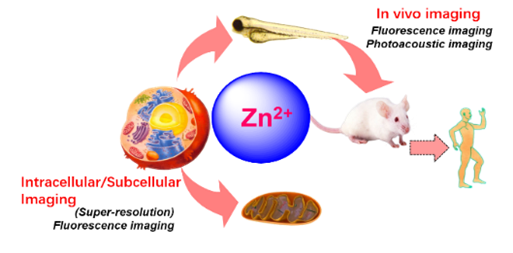
Probes for Zn2+ imaging: from organelles to in vivo applications.
Monitoring the spatiotemporal changes of Zn2+ in organelles, cells, and in vivo is of great importance to clarify the physiological and pathological roles of Zn2+ in signal transduction and neuron transmission. However, this task is quite challenging since Zn2+ in living systems is present at low concentrations and undergoes rapid dynamic changes. Our interests in this filed focus on the construction and imaging application of novel probes for Zn2+. In our study, super-resolution fluorescence imaging was adopted to realize simultaneous Zn2+ tracking in multiple organelles (Zn-STIMO) and the Zn2+ trafficking in autophagy was investigated. On the other hand, specific labile Zn2+ pools in zebrafish larvae have been demonstrated by 3D ratiometric fluorescence imaging using a specifically designed probe. Moreover, in vivo imaging for Zn2+ in mice has also been realized via photoacoustic imaging with a ratiometric probe, providing the promising potential to support the diagnostic study on Zn2+ related diseases. Our interests cover also the tracking of other essential transition metal cations such as Fe3+/Fe2+, and Cu2+/Cu+ in living systems.
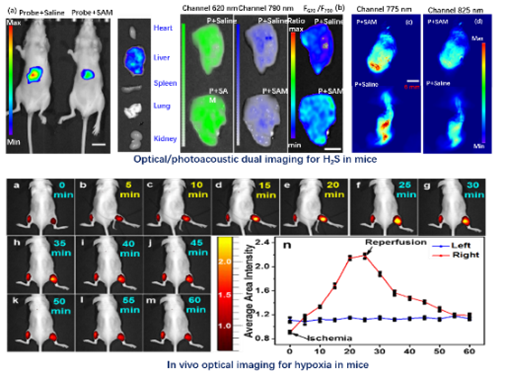
Tracking gaseous signaling species in cells and mice.
Small gaseous molecules such as NO, H2S and O2 are essential signaling molecules to regulate the metabolism, signal transduction associated with neurodevelopment, and vasodilation. Tracking the dynamic fluctuation of these molecules in living systems is especially demanded by the diagnostic study for diseases associated with these signaling species. Most reported probes for the three species function with reaction mechanisms, which makes these probes suffers from the delayed and irreversible response. Moreover, in vivo tracking of these species in mice via fluorescence imaging are challenging and offer many misleading information. Our inters in this field focus on the design of novel probes showing rapid and reversible response, and exploring reversible rapid
reaction of these species is the main task for this purpose. On the other hand, the additional imaging mode such as photoacoustic imaging has been adopted to offer more reliable in situ information of these species. This new imaging mode provides still the potential to track signaling species in the brain, which demands the small molecule probe showing BBB permeability.
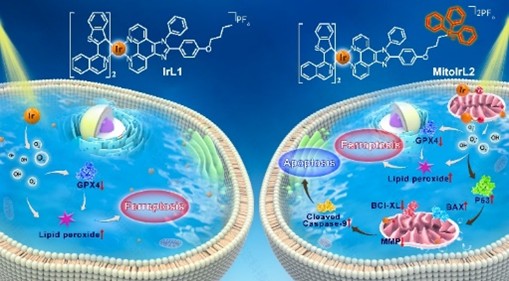
Photoactivable chemicals as anticancer agents.
Light irradiation can be spatiotemporally confined, which is especially appealing for cancer treatment to avoid normal tissue damage. Photoactivable chemicals acting as anticancer drugs is a promising strategy to overcome the side effects of normal anticancer drugs, and photodynamic therapy (PDT) becomes a hot topic in field of antitumor drugs especially the immunotherapeutic effect of PDT has been reported. However, the distinct oxygen-dependence makes the classic PDT agents invalid in solid tumor of hypoxic microenvironments. Our interests in this field focus on the development of novel photoactivable agents such as type I PDT agents showing low oxygen-dependent efficacy, chemical therapeutic agents of variable photoactivable mechanisms to trigger their therapeutic effect. Recently, the photo-induced carbenes were adopted as active species to damage biomolecules for cancer treatment in our lab. This provides a novel approach to nonoxygen-dependent PDT, showing the promising potential to overcome the main obstacle of classic PDT.
1. Z. Jiang, Z. Liang, Y. Cui, C. Zhang, J. Wang, H. Wang, T. Wang, Y. Chen,* W. He,* Z. Liu,* and Z. Guo, Blood−Brain Barrier Permeable Photoacoustic Probe for High-Resolution Imaging of Nitric Oxide in the Living Mouse Brain, J. Am. Chem. Soc., 2023, 145, 7952−7961.
2. M. Liu, Y. Chen,* Y. Guo, H. Yuan, T. Cui, S. Yao, S. Jin, H. Fan, C. Wang, R. Xie, W. He,* Z. Guo.* Golgi apparatus-targeted aggregation-induced emission luminogens for effective cancer photodynamic therapy, Nat. Commun, 2022, 13, 2179.
3. Y. Zhang, W. Zhao, Y. Chen,* H. Yuan, H. Fang, S. Yao, C. Zhang, H. Xu, Nan Li, Z. Liu, Z. Guo,* Q. Zhao*, Y. Liang, W. He.* Rational construction of a reversible arylazo-based NIR probe for cycling hypoxia imaging in vivo, Nat. Commun., 2021, 12, 2772.
4. H. Yuan, Z. Han, Y. Chen,* F. Qi, H. Fang, Z. Guo,* S. Zhang, W. He.* Ferroptosis Photoinduced by New Cyclometalated Iridium(III) Complexes and Its Synergism with Apoptosis in Tumor Cell Inhibition, Angew. Chem. Int. Ed., 2021, 60, 8174–8181
5. H. Fang, S. Geng, M. Hao, Q. Chen, M. Liu, C. Liu, Z. Tian, C. Wang, T. Takebe, J.-L. Guan, Y. Chen,* Z. Guo, W. He,*J. Diao.* Simultaneous Zn2+ tracking in multiple organelles using super-resolution morphology-correlated organelle identification in living cells, Nat. Commun., 2021, 12, 109.
6. Q. Chen, H. Fang, X. Shao, Z. Tian, S. Geng, Y. Zhang, H. Fan, P. Xiang, J. Zhang, X. Tian, K. Zhang,* W. He,* Z. Guo,*J. Diao.* A dual-labeling probe to track functional mitochondria–lysosome interactions in live cells, Nat. Commun., 2020, 11, 6290.
7. Z. Chen, X. Mu, Z. Han, S. Yang,* C. Zhang, Z. Guo,* Y. Bai, and W. He.* An Optical/Photoacoustic Dual-Modality Probe: Ratiometric in/ex Vivo Imaging for Stimulated H2S Upregulation in Mice, J. Am. Chem. Soc. 2019, 141, 17973−17977.
8. X. Xue, C. Qian, H. Fang, H.-K. Liu,* H. Yuan, Z. Guo,* Y. Bai, and W. He.* Photoactivated Lysosomal Escape of a Monofunctional PtII Complex Pt-BDPA for Nucleus Access, Angew. Chem. Int. Ed. 2019, 58, 12661-12666
