李 劼 教授
Prof. Jie Li
办公室:仙林化学楼E402
邮 箱: jieli@nju.edu.cn
2019-present Professor, Nanjing University
2015-2018 Post-doctoral Research Fellow, Scripps Research Institute, USA
2010-2015 PhD Student, Peking University, China
2006-2010 BS, Wuhan University, China
李劼 教授、博士生导师。2010年本科毕业于武汉大学,2015年在北京大学获得博士学位。2015年至2018年在美国Scripps研究所从事博士后研究工作。2018年底起担任南京大学教授、博士生导师。2019年入选江苏特聘教授,2020年入选国家级海外高层次青年人才,2025年入选国家杰青,主持国家自然科学基金原创探索计划项目、科技部重点研发计划课题等。主要研究方向包括:免疫识别的化学解码与重塑、免疫微环境的化学单细胞组学、金属元素的免疫功能以及新型免疫药物或细胞疗法的开发。
Chemical Decoding and Reprogramming of Immune Recognition
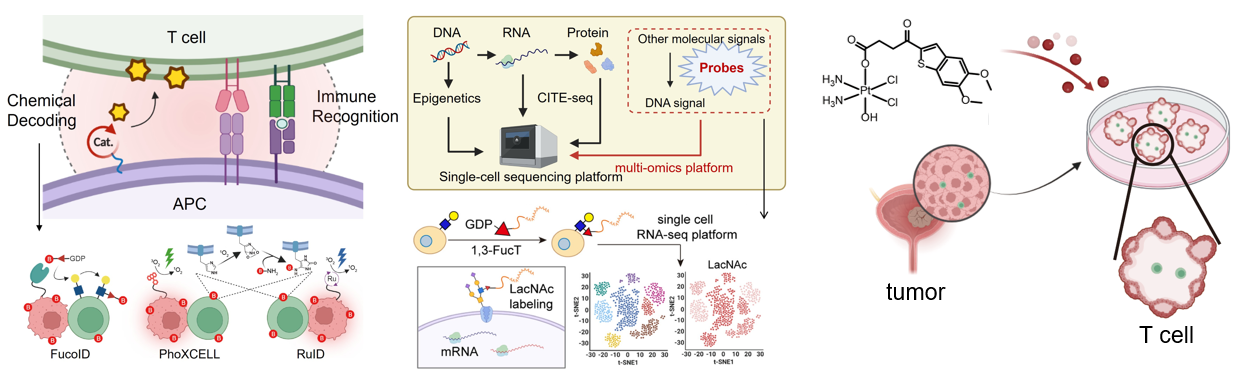
T-cell antigen recognition is a fundamental event in adaptive immunity, but antigen-specific T cells are often rare, heterogeneous and difficult to distinguish from bystander cells. In this context, our research work focuses on the development of proximity-based chemical tools to decode and manipulate immune recognition. We established interaction-dependent enzymatic and photocatalytic labeling strategies to capture antigen-specific T cells, and further developed chemical approaches to selectively deplete defined T-cell clones, enabling both molecular decoding and functional reshaping of immune recognition.
Chemical Single-cell Omics of the Immune Microenvironment
The immune microenvironment is composed of diverse cell types, dynamic cell-cell interactions and function-associated chemical features that cannot be fully resolved by transcriptomics alone. Our research work focuses on integrating chemical labeling with single-cell sequencing to profile these hidden layers of immune regulation. We developed chemical single-cell multiomics platforms to quantify cell-surface glycans, barcode living cells and map interaction-dependent cellular landscapes in vivo, thereby revealing functional immune states and communication patterns within tumor microenvironments.
Metal-mediated Immune Regulation
Metal-based compounds, especially platinum drugs, are widely used in cancer therapy, but their immune regulatory functions remain incompletely understood. In this context, our research work focuses on exploring how metal elements and metal-based drugs regulate tumor immunity. We designed platinum-based metalloimmunotherapeutic molecules that combine chemotherapy with innate immune activation, and established patient-derived immunocompetent tumor organoids to evaluate chemotherapy in the context of T-cell recognition. These studies aim to redefine metal drugs as modulators of immune recognition and antitumor immunity.
1. Wang Z†, Xiang F†, Liao X†, Wu Q, Jiao J, Bi A, Liu S, Wang D, Wang M, Guo Z*, Li J*, Inert Complexes Unlock Ligand-Accelerated Transition-Metal Catalysis on Proteins, Angew. Chem. Int. Ed., 2026, e22057.
2. Deng T†; Jiang X†; Zhao Z; Zhao X; Bi A; Ouyang S; Sun S; Qiu S; Fan M; Xue Q; Yu W; Yang Y; Li W; Wu Y; Huang X; Zhong D; Qin S; Zhu W; Li J*, CINTER-seq: Chemical profiling reveals interaction-dependent cell landscapes and gene signatures in vivo, Immunity, 2025, 58, 2336-52.
3. Wu Y†, Deng T†, Song L†, Zhu W, Zhong D, Jiao J, Li W, Zhong L, Tian T, Dong L*, Li J*, “Clone-Resolved Chemical Depletion of T cells via Cellular Proximity Chemistry”, Angew. Chem. Int. Ed., 2025, 64, e202425628.
4. Xue Q†, Peng J†, Dai W†, Wu Q, Jiao J, Hu Y, Sha W, Yang Y, Yu W, Liu S, Xu T*, Li J*, A biparatopic HER2-targeting ADC constructed via site-specific glycan conjugation exhibits superior stability, safety, and efficacy, RSC Chem. Bio., 2025, 6, 1284-96
5. Pan Y†, Xue Q†, Yang Y†, Shi T, Wang H, Song X, Luo Y, Liu W, Ren S, Cai Y, Nie Y, Song Z, Liu B, Li J*, Wei J*, “Glycoengineering-based anti-PD-1-iRGD peptide conjugate boosts antitumor efficacy through T cell engagement”, Cell Rep. Med., 2024, 5, 6, 101590.
