梁勇 教授
Prof. Yong Liang
办公室:仙林化学楼D505
邮 箱:yongliang@nju.edu.cn
电 话:0086-025-89681983
2015-present Professor, Nanjing University
2012-2015 Post-doctoral Research Fellow, University of California, Los Angeles
2005-2010 Ph.D. in Chemistry, Peking University
2001-2005 B.S. in Chemistry, Peking University
梁勇,教授、博士生导师、江苏特聘教授。2005年获北京大学学士学位;2010年获北京大学理学博士学位。2012-2015年,美国加州大学洛杉矶分校,化学与生物化学系博士后。2015年11月至今,南京大学化学化工学院教授。2015年国家级青年人才计划入选者,2017年获中国化学会—物理有机化学新人奖,2019年江苏省“双创”团队领军人才,2020年获霍英东教育基金会第十七届高等院校青年教师奖,2022年获南京大学青年五四奖章,2025年获国家自然科学基金青年科学基金项目(A类)资助。主要研究方向:(1)计算和实验相结合研究有机化学反应的机理;(2)天然产物生物合成中涉及的有机反应和酶催化机制;(3)计算机辅助设计用于有机合成的新催化剂和反应;(4)计算指导新生物正交试剂的设计与应用。
Mechanistic Elucidation of Novel Enzyme-Catalyzed Reactions
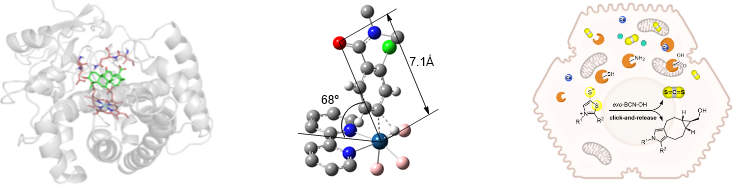
Efficient simulation of complex enzyme-catalyzed systems, particularly those involving previously unexplored enzymatic transformations, remains a major challenge in computational chemistry. Conventional theoretical approaches are often insufficient for understanding and predicting mechanistically unknown enzymatic reactions involved in the biosynthesis of complex natural products. Our research aims to uncover the molecular mechanisms underlying complex enzyme-catalyzed reactions, particularly those involved in natural product biosynthesis. We develop and apply a new strategy, which coupled molecular dynamics (MD) simulations with the theozyme model, to predict enzymatic activity and selectivity. These studies have revealed previously unknown catalytic mechanisms and provided fundamental insights into how enzymes control challenging chemical transformations.
Site-Selective Catalysis
A central goal of our research is to achieve precise control over site selectivity in arene C–H functionalization. While ortho-selective reactions can often be directed through proximity effects, selective activation of remote meta and para C–H bonds remains a major challenge due to their similar reactivity and distance from directing groups. Guided by DFT calculations, we design catalysts that exploit geometric constraints and noncovalent interactions to achieve substrate recognition and regioselective control. Using this approach, we developed iridium-catalyzed C–H borylation reactions with tunable meta- and para-selectivity, demonstrating how rational catalyst design can overcome longstanding limitations in remote C–H functionalization.
Multifunctional Bioorthogonal Reagent Design
Bioorthogonal reactions have become indispensable tools in chemical biology, enabling the selective manipulation and visualization of biomolecules in complex biological environments. However, the discovery of new bioorthogonal reagents through experimental synthesis and screening is often time-consuming and resource-intensive, making computational approaches particularly attractive. Our research combines density functional theory (DFT) calculations and kinetic analyses to systematically investigate the mechanisms of bioorthogonal cycloaddition reactions. By elucidating the key factors governing reactivity and selectivity, we have established quantitative structure–reactivity relationships and developed kinetic heat maps for bioorthogonal cycloadditions. These predictive tools enable the rapid evaluation and screening of potential bioorthogonal reactions, facilitating the discovery of new bioorthogonal ligations as well as mutually orthogonal reaction pairs for multiplexed biological applications.
1. A light-driven enzymatic enantioselective radical acylation, Xu, Y.; Chen, H.; Yu, L.; Peng, X.; Zhang, J.; Xing, Z.; Bao, Y.; Liu, A.; Zhao, Y.; Tian, C.*; Liang, Y.*; Huang, X.*, Nature 2024, 625, 74-78.
2. Computational Design of Ligands for the Ir-Catalyzed C5-Borylation of Indoles through Tuning Dispersion Interactions, Zheng, T.; Ma, J.; Chen, H.; Jiang, H.; Lu, S.; Shi, Z.; Liu, F.*; Houk, K. N.*; Liang, Y.*, J. Am. Chem. Soc., 2024, 146, 25058-25066.
3. Bioorthogonal Delivery of Carbon Disulfide in Living Cells, Zhao, R.; Chen, Y.*; Liang, Y.*, Angew. Chem. Int. Ed., 2024, 63, e202400020.
4. Enzymatic catalysis favours eight-membered over five-membered ring closure in bicyclomycin biosynthesis, He, J.-B.; Wu, L.; Wei, W.; Meng, S.; Liu, Z.-T.; Wu, X.; Pan, H.-X.; Yang, S.; Liang, Y.*; Zhou, J.*; Tang, G.-L.*, Nat. Catal. 2023, 6, 637-648.
5. Computationally designed ligands enable tunable borylation of remote C–H bonds in arenes, Chang, W.; Chen, Y.; Lu, S.; Jiao, H.; Wang, Y.; Zheng, T.; Shi, Z.; Han, Y.; Lu, Y.; Wang, Y.; Pan, Y.; Yu, J.-Q.; Houk, K. N.; Liu, F.; Liang, Y.*, Chem, 2022, 8, 1775-1788.
