
汪蓉 教授
Prof. Rong Wang
办公室:仙林化学楼E405
邮 箱:wangrong@nju.edu.cn
2013-present Professor, Nanjing University
2006-2008 Research Fellow, National University of Singapore
2003-2012 Associate Professor, Nanjing University
2001-2003 Post-doctor Fellow, Fudan University
1998-2001 PhD student, Sichuan University
汪蓉 教授、博士生导师。2001年获四川大学原子与分子物理博士学位,2001年9月至2003年8月在复旦大学高分子科学系做博士后研究,2003年11月到南京大学工作至今,2006年10月至2008年2月在新加坡国立大学做访问研究。曾主持国家自然科学基金青年基金、面上项目以及重大研究计划培育项目多项,并以学术骨干参与国家自然科学基金重点项目3项和973项目1项以及国防科技基础加强计划1项。主要研究方向:高分子和生物分子组装的理论模拟、两亲分子智能设计、材料的形态设计和性能仿真。
Controllable Design of Colloidal Molecules by DNA-Programmable Assembly
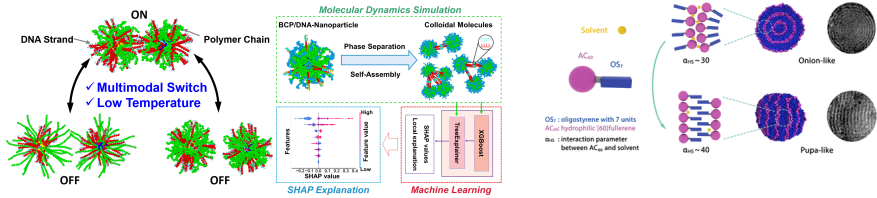
Colloidal molecules exhibit unique electronic, optical, and magnetic properties owing to their molecular-like configurations and coupling effects, making them promising building blocks for multifunctional materials. However, achieving precise and controllable assembly of isotropic nanoparticles with high yields remains a great challenge. The synergistic strategy that integrates molecular dynamics simulations and interpretable machine learning was used to program the assembly of block-copolymer and DNA-functionalized nanoparticles into stable colloidal molecules, achieving precise, high-yield assembly. SHAP analysis was used to identify key structural descriptors and clarifies mechanisms governing ordered coassembly.
Stimuli-Responsive Polymers Trigged Design of ON-OFF Nanoswitches
It is a challenging task to realize highly reversible ON-OFF nanoswitches over a wide range of temperature, which emerge as a versatile toolbox for use in artificial biotechnologies. Herein, nanoparticles (NPs) bifunctionalized by DNA strands and stimuli-responsive polymers are proposed to construct multimodal ON-OFF nanoswitches by the coarse-grained model. The synergy between the transition of contraction and expansion configurations of stimuli-responsive polymers and the hybridization-dehybridization event of DNA strands results in the achievement of multimodal ON-OFF nanoswitches of bifunctionalized NPs in spite of the condition of lower temperature. Importantly, our simulations isolate the conditions of programmable self-assembly of bifunctionalized NPs to realize the multimodal ON-OFF nanoswitches by the changes of temperature and chain rigidity. In addition, it is found that the bifunctionalized NPs in the ON state displays the anisotropic and patchy features due to an introduction of stimuli-responsive polymers.
Self-assembly of Complex Block Copolymers
Over the past few decades, researchers have paid much attention to the fact that sub-10 nm nanostructures have played an important role in helping to reduce the size of nanofabrication. Our theoretical simulation demonstrates the formation of open layered (pupa-like micelles) and closed layered (onion-like micelles) nanostructures, self-assembled from giant surfactants with comparably sized hydrophilic heads tethered by oligomers in solution. Directed by these simulation results, we synthesized giant surfactants consisting of hydrophilic [60]fullerene heads and oligostyrene (OS7) tails and produced the predicted nanostructures with periods of 9.5, 8.3, and 7.5 nm, experimentally. Adjusting the polarity of the solvent and corresponding concentration changed the nanostructures from onion-like micelles with closed layers to pupa-like micelles with open layers.
1. Directional Self-Assembly of Programmable Atom-like Nanoparticles into Colloidal Molecules, Xiandeng Qiu, Hao Tang, Liangshun Zhang*, Rong Wang*, J. Phys. Chem. Lett., 2025, 16, 3141
2. Templated Fabrication of DNA-Programmable Vesicles via Amphiphile-Functionalized Nanoparticles, Hao Tang, Xiandeng Qiu, Daiqian Xie*, Rong Wang*, Macromolecules, 2025, 58, 3082
3. Kinetics of DNA-Mediated Liposome Fusion with Different Binding Modes, Hao Tang, Xiandeng Qiu, Rong Wang*, Biomacromolecules, 2025, 26, 8323
4. Block Copolymer aided Controllable Design of Colloidal Molecules by DNA-Programmable Assembly, Xiandeng Qiu, Hao Tang, Rong Wang*, Chin. J. Polym. Sci., 2025, 43, 2213
