
周东山 教授
Prof. Dongshan Zhou
办公室:仙林化学楼C401
邮 箱:dzhou@nju.edu.cn
2010-present Professor, Department of Polymer Science and Engineering, Nanjing University
2005-2010 Associate Professor, Department of Polymer Science and Engineering, Nanjing University
2006-2008 Humboldt Research Fellow, Institute of Physics, Rostock University,
2000-2003 PhD, Department of Polymer Science and Engineering, Nanjing University
1997-2000 MS, Department of Earth Science, Nanjing University
1993-1997 BS, Department of Chemical Engineering, Nanjing University
周东山,南京大学化学化工学院高分子科学与工程系、配位化学国家重点实验室教授、博士生导师,南京大学科技处副处长、先进技术研究院副院长,南京大学射阳高新技术研究院院长。2003年获南京大学高分子科学系博士学位,获得2005年度全国百篇优秀博士学位论文。2005年受聘为化学化工学院副教授,2010年晋升为教授并入选教育部新世纪人才计划。期间,受德国洪堡基金会资助,于2006年8月至2008年6月在德国罗斯托克大学物理研究所从事合作研究。主要研究领域为高分子的结构转变及动力学行为、功能高分子复合材料、高速高灵敏量热仪研制与应用。获得2014年度江苏省科技进步一等奖(第2完成人)及2015年度国家科技进步二等奖(第2完成人)。
Development of advanced calorimetric techniques and their applications in the study of condensed structure of functional polymer
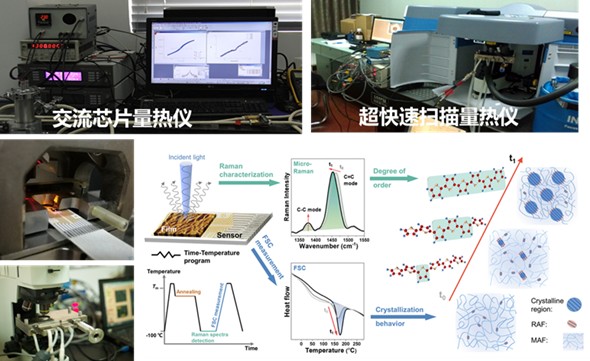
Traditional DSC measurement techniques often encounter difficulties such as ambiguous attribution of endothermic or exothermic peaks, certain characteristic peaks being easily masked, and the detection of weak transitions being challenging, especially when dealing with multiphase samples, micro/nano-level samples, or samples with complex thermal histories. Based on chip calorimetric technology, our group has developed alternating current chip calorimeters (ac chip calorimetry) and stage-type ultrafast scanning calorimeters, which can perform ultra-sensitive and ultra-fast calorimetric analysis on nanogram-level samples. They respectively have resolutions of pJ/K and temperature ramp rates of 106 K/s, suitable for capturing metastable states and analyzing thermodynamic behaviors of one-dimensional and two-dimensional materials.
Computationally guided non-equilibrium synthesis
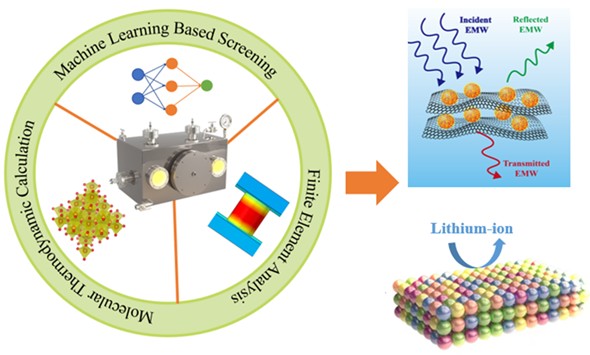
Conventional material design and synthesis not only require significant time and experimental investment but also have difficulty in capturing diverse non-equilibrium products. We have developed a highly stable and fast thermal processing platform for non-equilibrium synthesis. By combining the thermal processing platform with machine learning and multi-scale physical computation, the platform enables efficient design of products, efficient screening of synthesis conditions, and efficient realization of the synthesis process.
We focus on this means in the lithium-ion battery high-entropy electrode materials, transition metal alloy wave-absorbing composite materials to carry out related work, to promote the electrode material cycle stability and energy density, and to promote a new generation of wide-frequency domain, strong absorption of wave-absorbing materials optimization and development.
Design and fabrication of high-performance flexible electronic skin
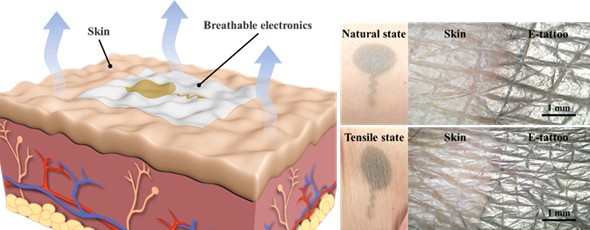
Flexible electronic skin (E-skin) technology is driving the rapid development of soft robotics, human-machine interfaces, health monitoring, and smart prosthetics. We have done a series of research work around the device's sensing properties, preparation process, and wearing comfort. For example, we have recently designed and prepared an ultra-thin, breathable, and multifunctional electronic tattoo that can monitor signals such as physiological electricity, skin water content, and tactile sensation without being perceptible to the human body.
1. Real-time correlation of crystallization and segmental order in conjugated polymers, Shaochuan Luo, Yukun Li, Nan Li, Zhiqiang Cao, Song Zhang, Michael U. Ocheje, Xiaodan Gu, Simon Rondeau-Gagne´, Gi Xue, Sihong Wang, Dongshan Zhou*, Jie Xu*, Materials Horizons, 2024, 11, 196-206.
2. Ultrathin and highly breathable electronic tattoo for sensing multiple signals imperceptibly on the skin, Yan Zheng, Yukun Li, Yan Zhao, Xiaohu Lin, Shaochuan Luo, Yong Wang, Linling Li, Chao Teng, Xiaoliang Wang*, Gi Xue, Dongshan Zhou*, Nano Energy, 2023, 107, 108092.
3. Dynamic/static mechanical stimulation double responses and self-powered “green” electronic skin based on electrode potential difference, Yan Zheng, Chenchen Dong, Ying Li, Wansu Peng, Yukun Li, Yong Wang, Xiaoliang Wang *, Chao Teng*, Dongshan Zhou*, Gi Xue, Chemical Engineering Journal, 2022, 433, 134412.
4. Highly sensitive electronic skin with a linear response based on the strategy of controlling the contact area, Yan Zheng, Tong Lin, Ning Zhao, Caixiu Huang, Wei Chen, Gi Xue, Yong Wang, Chao Teng, Xiaoliang Wang*, Dongshan Zhou*, Nano Energy, 2021, 85, 106013.
5. High conductivity and stability of polystyrene/MXene composites with orientation-3D network binary structure, Yan Zheng, Wanyi Chen, Yi Sun, Caixiu Huang, Zhaoqun Wang*, Dongshan Zhou*, Journal of Colloid and Interface Science, 2021, 595, 151-158.
6. A high performance SnO2/C nanocomposite cathode for aluminum-ion batteries, Hongyan Lu, Yuanxin Wan, Tianyi Wang, Rong Jin, Peitao Ding, Rong Wang, Yong Wang, Chao Teng, Linling Li, Xiaoliang Wang*, Dongshan Zhou* and Gi Xue, Journal of Materials Chemistry A, 2019, 7, 7213.
7. Interplay between Free Surface and Solid Interface Nucleation on Two-Step Crystallization of Poly(ethylene terephthalate) Thin Films Studied by Fast Scanning Calorimetry, Shaochuan Luo, Xing Kui, Enran Xing, Xiaoliang Wang, Gi Xue, Christoph Schick, Wenbing Hu, Evgeny Zhuravlev*, Dongshan Zhou*, Macromolecules, 2018, 51, 14, 5209-5218.
8. Micron-sized iron-oxide secondary particles as anode material for high volumetric-energy-density of lithium-ion batteries, Xiaoqian Xu, Yuanxin Wan, Chen Zuo, Haipeng Yan, Muting Du, Gi Xue, Dongshan Zhou*, Materials Today Energy, 2018, 7, 80-86.
